Handle wood is half the knife. I pick every piece by hand — grain, colour, how it'll feel after a year in someone's kitchen. These are the ten woods I work with and what I actually think of each one.
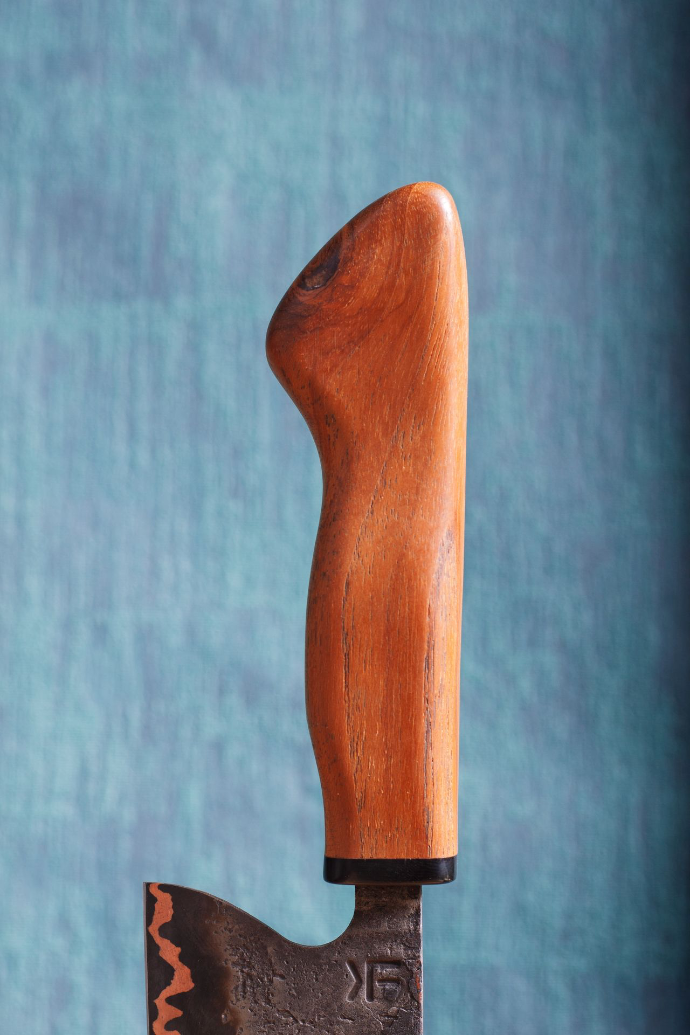
Teak
My most-used handle wood. It comes from Southeast Asia — Burma, Thailand, Indonesia — and has been used in boatbuilding for centuries because it genuinely resists moisture and rot. Those same properties make it good for kitchen knives, where handles get wet and dry out repeatedly. Most woods struggle with that cycle. Teak doesn't.
In the hand it feels solid and slightly waxy, smooth without being slippery. The grain is straight, the colour a warm golden-brown that mellows further with age. It's not the most visually dramatic option I offer, but it ages honestly and doesn't require much from you. If you want something that'll still look decent in ten years with minimal upkeep, teak is probably the right choice.
Knives with a teak handle:
80CrV2 Santoku ·
San Mai Nakiri ·
Black Cumai Chef's ·
Wrought Iron Santoku ·
San Mai Chef's, Teak & Blackwood
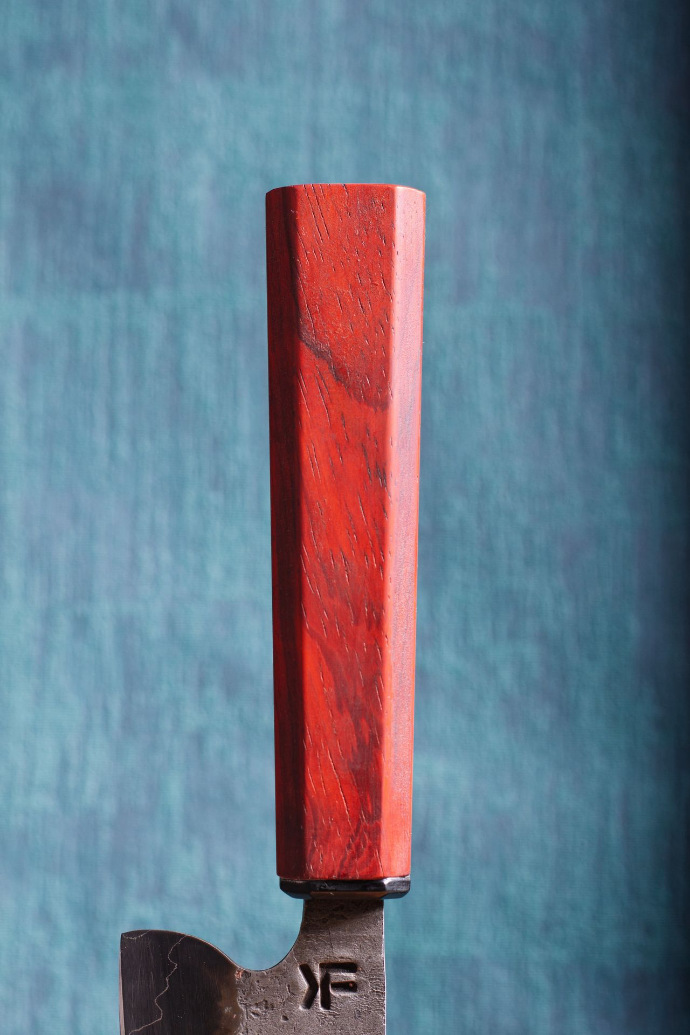
Padouk
Hard to miss. Padouk comes from Central and West Africa and the colour when it's freshly worked is a strong orange-red — not subtle, not going to blend in. It darkens over time toward a deeper red-brown as the wood oxidises and the light gets to it. Some people prefer it new; others like it better after a year. Both are reasonable positions.
It machines and finishes cleanly, and in the hand it feels dense — there's real weight to it even in a light wa handle. I reach for padouk on darker blades specifically, because the contrast between a bright reddish handle and a blackened or deep-etched steel is striking. If you want the handle to be part of the visual story of the knife, padouk earns its place.
Knives with a padouk handle:
Black Cumai Chef's ·
Nitro-B Chef's
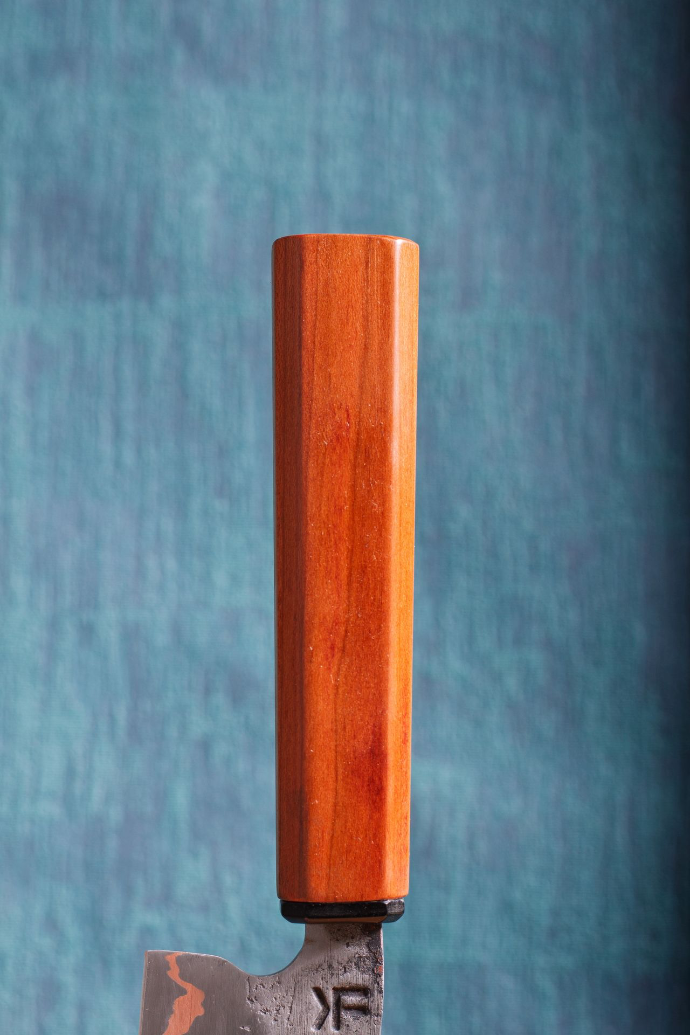
Pao Rosa
My favourite. It comes from Central Africa and sits somewhere between padouk and rosewood in colour — warm reddish-brown, fine even grain. That fine grain is what I like most practically: it takes an octagonal shape cleanly and holds it without the facets softening over time.
What makes pao rosa particularly good for a knife you're going to keep is how it ages. Regular oiling deepens the colour and smooths the surface, and after a couple of years it looks like something that's been genuinely cared for rather than just maintained. Some woods peak right after finishing. Pao rosa gets better.
Knives with a Pao Rosa handle:
San Mai Chef's ·
Big Birtha ·
Nitro-B Chef's ·
Silver Cumai
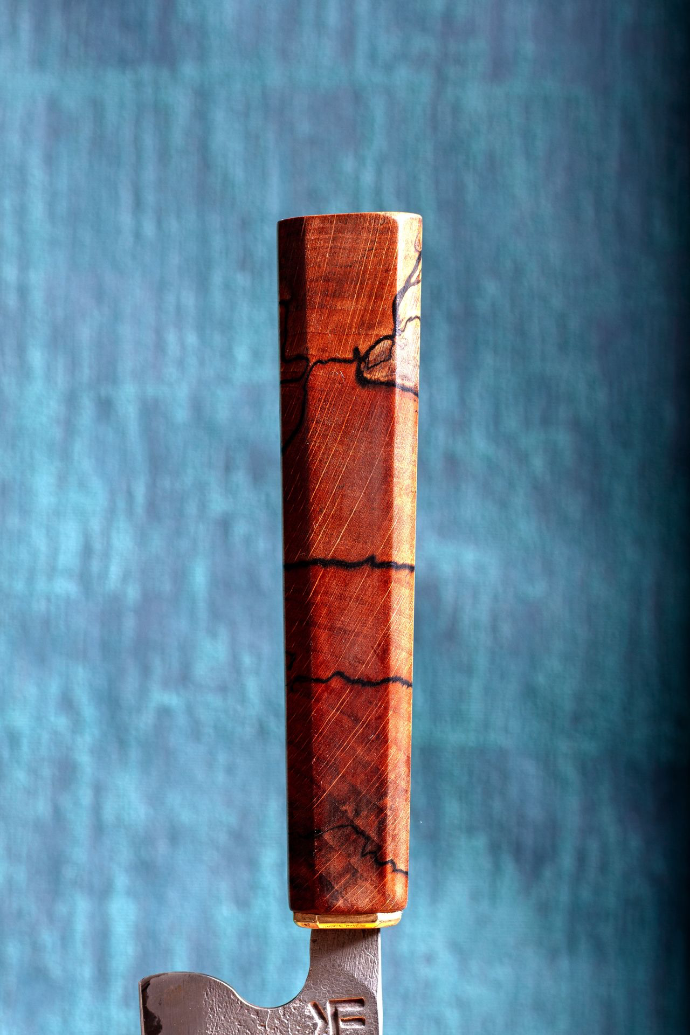
Spalted birch
Regular birch is a pale, fairly soft European hardwood. Spalted birch is what happens when a birch log sits in damp conditions long enough for fungi to colonise it. The black lines are zone lines — boundaries between competing fungal colonies. The softer, discoloured patches are where the wood broke down unevenly. Every piece comes out different; I can't predict what I'll find inside a blank until I start shaping it.
Before it becomes a handle, I stabilise it under vacuum with resin. That stops the process, hardens the soft spots, and makes the wood usable without worrying about it continuing to change. The result is light and unlike anything else in my shop. If you want a handle that looks like nothing else in anyone's knife block, spalted birch is it.
Knives with a spalted birch handle:
San Mai Chef's #1 ·
San Mai Chef's #2 (purple dyed)
Purple Heart
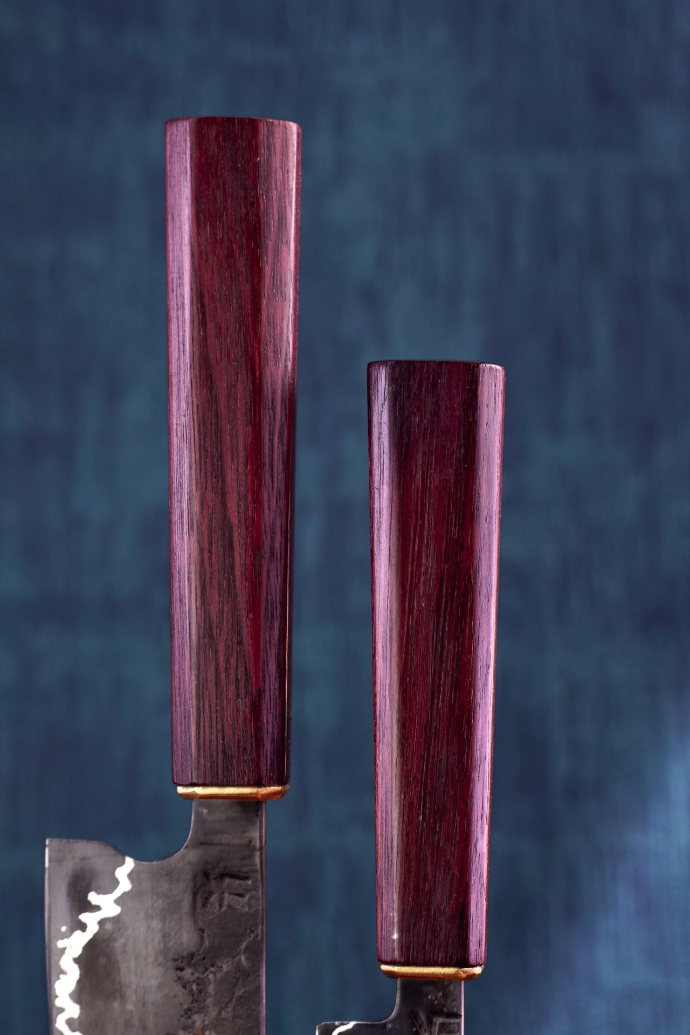
Genuinely purple when freshly worked — the kind of colour that makes people stop and ask what it is. It comes from Central and South America and is one of the harder tropical hardwoods I use. Sun exposure fades it over time toward a brownish-purple; oiling it regularly and keeping it out of direct light slows that down, though some people don't mind the fade.
Dense and smooth in the hand. The facets on an octagonal handle stay crisp because the wood is hard enough to hold its shape over years of use. It works with most blade steels because it's distinct enough to hold its own regardless of what it's next to.
Knives with a Purple Heart handle:
Nitro-B Bunka ·
Nitro-B Petty, Purple Heart & Zebrano
Olive wood
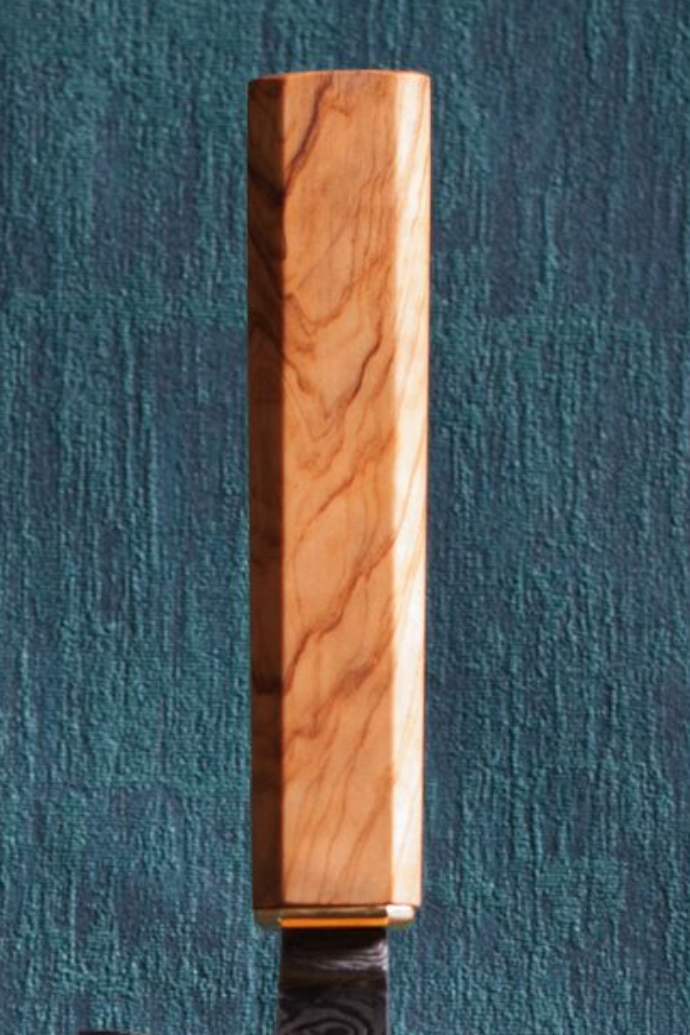
Slow material. The grain is interlocked and irregular, which means it pushes back when you're shaping it, and you can't predict exactly what's inside a piece until you're working it. Olive wood comes from Mediterranean olive trees — usually pruned branches or trees already at the end of their productive life, since olive isn't harvested at scale for timber. That explains the density and the tightness of the grain.
In the hand it's smooth, slightly cool, and heavier than it looks. The colour is warm yellow-brown with darker streaks that run in no predictable direction. I don't use it often, not because there's anything wrong with it, but because it suits specific blade styles — blades with a lot going on visually, where the wood's natural complexity fits rather than competes.
Knives with an olive wood handle:
Damascus Chef's
Pear wood
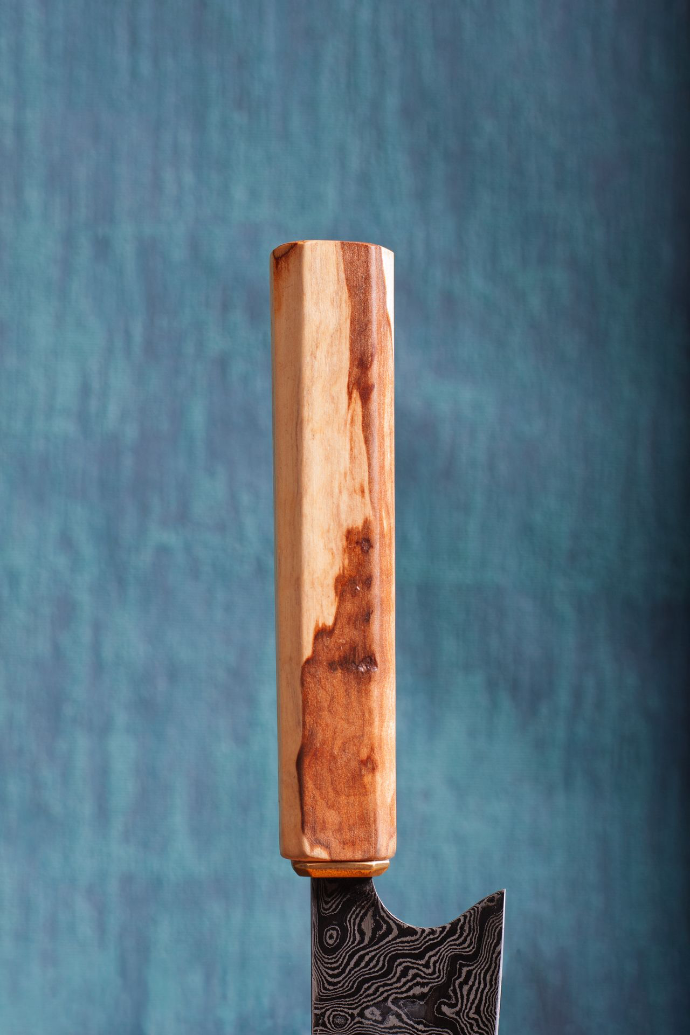
Pale, almost white when freshly worked, with a faint pink tone if the light catches it right. Very fine grain, takes a smooth finish without much effort. The surface feels close to silky in the hand. The colour is quiet, which I think is an underrated quality in a handle — not everything needs to announce itself.
The piece I used came from an old pear tree, and I like knowing that. There's a difference between wood off an industrial pallet and wood you can actually trace back to something. The handle sits next to a ladder Damascus blade where the pattern is doing all the visual work; the pear's job is to not compete, and it doesn't.
Knives with a pear wood handle:
Ladder Damascus Chef's
Bubinga
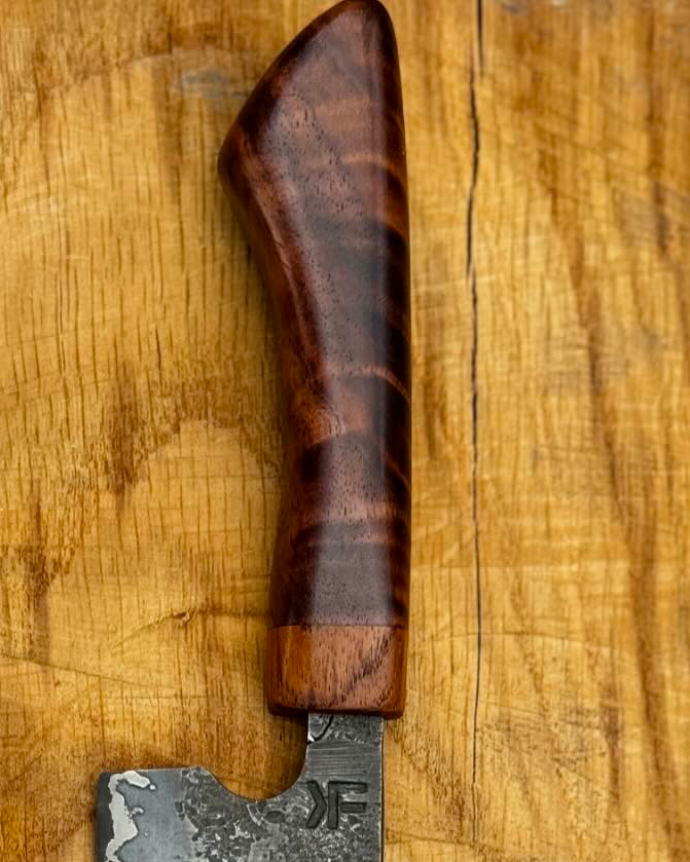
A large African hardwood from the rainforests of Central Africa. The colour is reddish-brown with a darker figure running through it — sometimes straight lines, sometimes a wavy, almost rippled pattern. The piece I use has that figured grain, which is what made me pick it for the Go-Mai knife.
It's hard and stable, and machines cleanly. In the hand it feels substantial. The striped figure in the wood and the lightning pattern in the layered blade looked right next to each other in a way I couldn't have predicted before I held them together. Some pairings are arbitrary. This one wasn't.
Knives with a bubinga handle:
Go-Mai Chef's (sold out)
African Blackwood
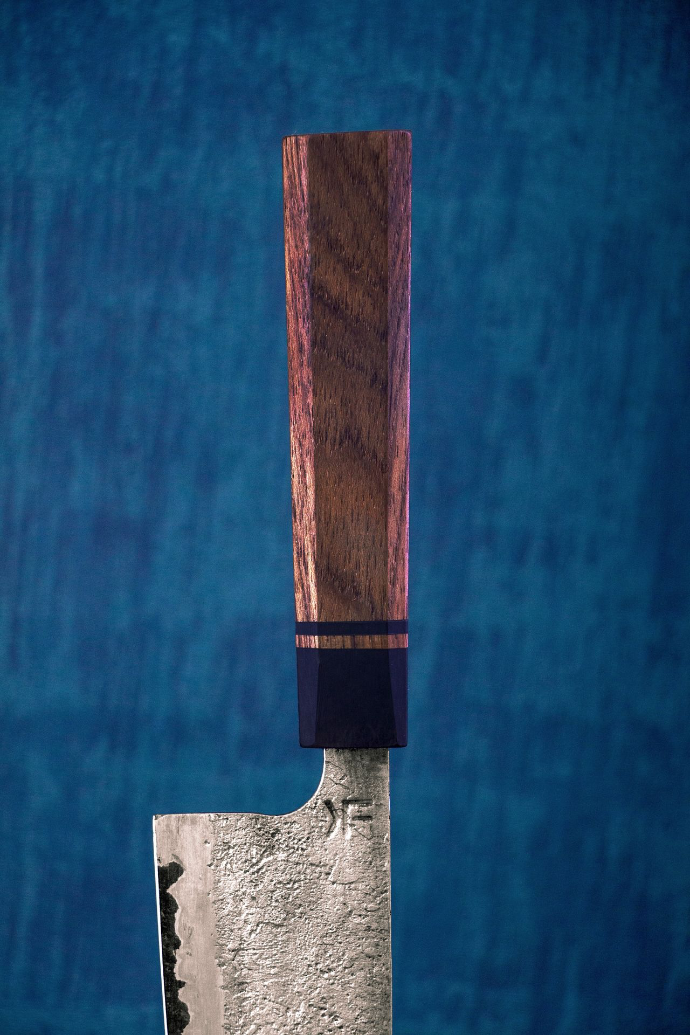
Dalbergia melanoxylon — a tree from dry woodlands across sub-Saharan Africa. Instrument makers use it for clarinets and oboes because it's that dense, that fine-grained, and it takes that quality of finish. Near-black with very faint figuring if you look closely. Working it is slow; it blunts tools faster than almost anything else I use.
The result is a surface that polishes close to glass and holds that finish without much upkeep. I use it alongside teak because the contrast is immediate — near-black next to warm brown, and both materials look intentional. It's a combination that works precisely because the two woods are so different.
Knives with an African Blackwood handle:
San Mai Chef's, Teak & Blackwood
Zebrano
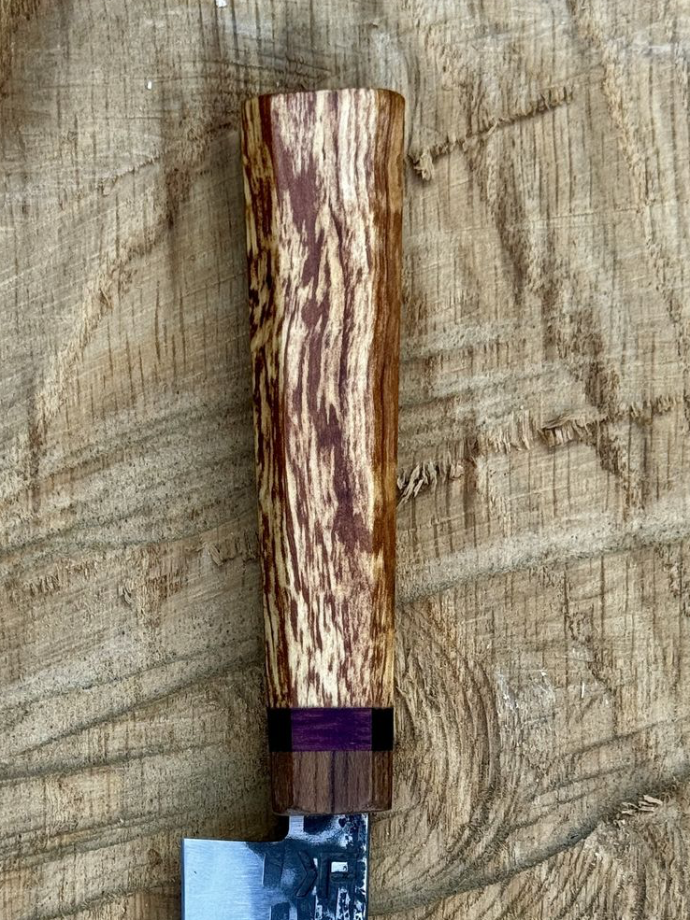
Bold yellow and dark brown stripes, coarser grain than most of what I use. Zebrawood comes from West Africa and the pattern is impossible to miss — it's a material that wants attention. I don't use it solo for that reason; it needs something to balance against.
On the petty knife I paired it with Purple Heart. Two loud materials, which sounds like a bad idea. In practice the purple and the striped yellow-brown end up as a pairing rather than a fight — different enough in colour and pattern that the eye reads them as deliberate. I wasn't sure about it until I saw it finished.
Knives with a zebrano handle:
Nitro-B Petty, Purple Heart & Zebrano